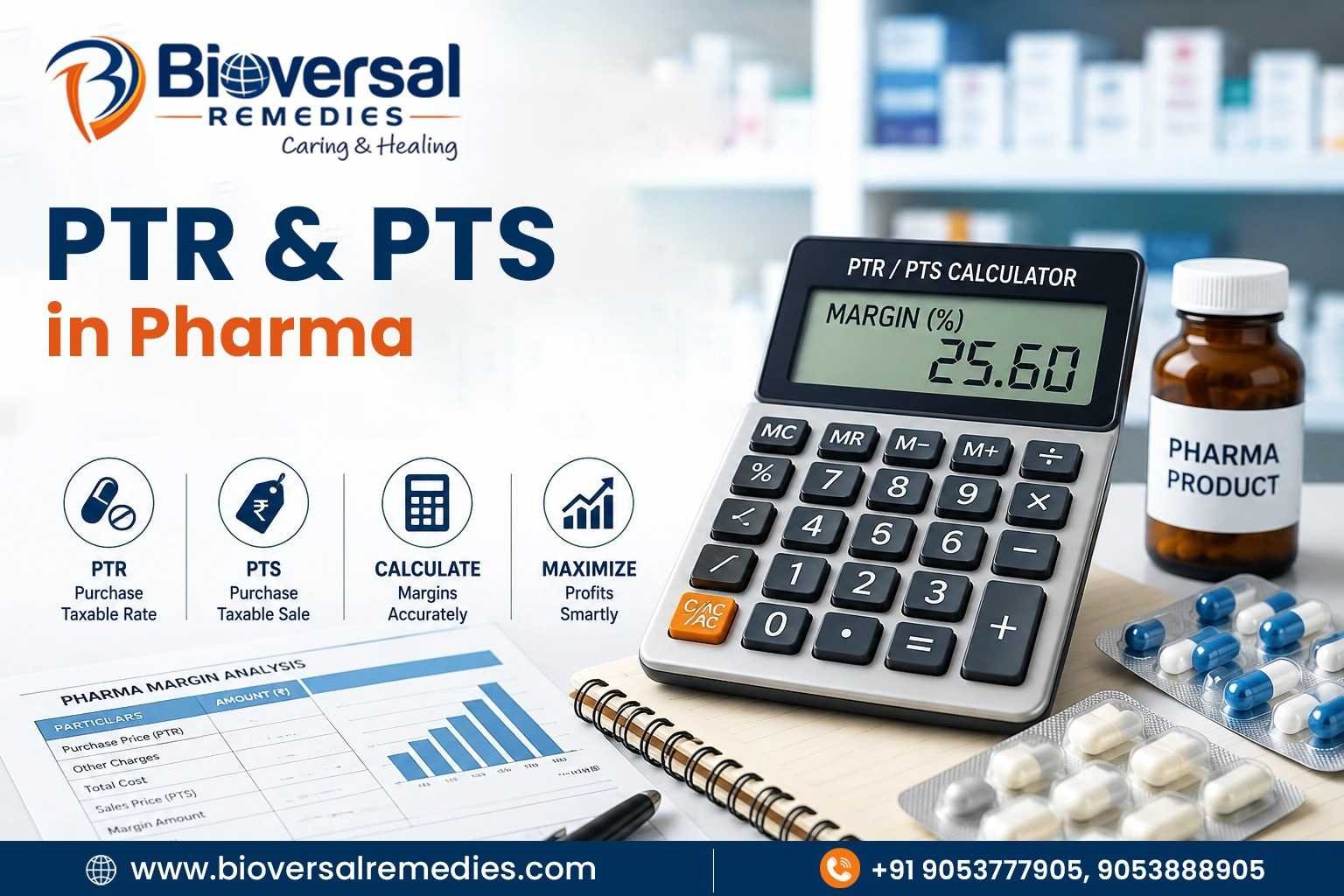
Two short abbreviations decide how much money a pharma distributor actually keeps. If you are comparing franchise offers, rate lists, or schemes, you will see PTR and PTS in pharma quoted everywhere, usually without explanation. This guide explains what they mean, how to calculate them step by step, and why the numbers changed after the September 2025 GST cut, something many older articles still get wrong.
Table of Contents
ToggleThe Price Ladder From Factory to Patient
A medicine passes through several hands before it reaches the patient, and each hand has its own price.
| Term | Stands for | Who pays it |
|---|---|---|
| MRP | Maximum Retail Price | The patient, printed on the pack |
| PTR | Price to Retailer | The chemist, when buying from the stockist or distributor |
| PTS | Price to Stockist | The stockist, when buying from the company |
Some traders also say PTC (price to customer), which is simply the MRP. In a PCD franchise, the partner commonly buys at a rate close to PTS and sells to chemists at PTR, so the spread between the two is the working margin, before schemes and costs.
The Formulas, Step by Step
- Start with MRP. This is the printed price and it includes GST.
- Subtract the retailer margin. If the retailer margin is 20%, take 20% off the MRP.
- Remove GST. Divide that figure by (1 + GST rate). This gives the PTR, quoted before tax.
- Subtract the stockist margin from PTR. If the stockist margin is 10%, PTS equals PTR minus 10% of PTR.
In short: PTR = (MRP minus retailer margin) divided by (1 + GST), and PTS = PTR minus (PTR times stockist margin).
A Worked Example at 5% GST
Take a product with an MRP of ₹100, a 20% retailer margin, and a 10% stockist margin.
- MRP after retailer margin: 100 minus 20 = ₹80
- PTR: 80 divided by 1.05 = ₹76.19
- Stockist margin: 10% of 76.19 = ₹7.62
- PTS: 76.19 minus 7.62 = ₹68.57
Why the 2025 GST Change Matters Here
Until 21 September 2025, most medicines carried 12% GST. From 22 September 2025, following the 56th GST Council meeting, most medicines moved to 5%, while a notified list of life-saving drugs went to nil. The 12% slab no longer applies to medicines at all.
That matters because GST sits inside your formula. Run the same example at the old 12% rate and you get a PTR of ₹71.43 and a PTS of ₹64.29. At the same MRP, the lower tax leaves a higher pre-tax price, so PTR and PTS come out higher at 5%. If a calculator or rate sheet still divides by 1.12, it is out of date for most products.
Two cautions. First, many companies revised MRPs after the cut, so use the current printed MRP rather than an old one. Second, stock bought before 22 September 2025 was invoiced at 12%, which can complicate returns and credit notes for older batches.
Schemes and Your Real Margin
A scheme such as “10 plus 1” gives the buyer one free unit for every ten bought. On a PTR of ₹76.19, that works out to an effective rate of about ₹69.26 per unit for the chemist (76.19 times 10, divided by 11). That is roughly a 9% discount, and someone has to fund it. Before you offer or accept schemes, calculate who absorbs the cost, because a generous scheme on a thin margin can erase your profit.
Mistakes People Make With PTR and PTS
- Assuming one margin convention. Companies differ on whether the retailer margin is applied to MRP or to the pre-tax price. Confirm the convention before comparing offers.
- Mixing inclusive and exclusive prices. PTR and PTS are normally quoted before GST. MRP includes it.
- Ignoring price-controlled drugs. Medicines under national price control follow regulated ceiling prices, so margins there are set by rule rather than negotiation.
- Comparing rates without comparing quality. A low PTS means little if the manufacturer cannot show certification and batch documentation.
Check Your Numbers Before You Commit
Bioversal Remedies provides a PTR and PTS calculator for quick estimates. Whatever tool you use, confirm that the GST rate applied matches the product’s current rate. If you are weighing a franchise, read how the PCD pharma franchise and monopoly PCD pharma franchise models work, browse the product list, or ask for a rate sheet through our contact page.
The Bottom Line
Understanding PTR and PTS in pharma takes about ten minutes and protects you from the most common cost mistakes in this trade. Know the ladder, use the current GST rate, work out the effect of schemes, and compare rate sheets on the same basis. Do that, and every offer you receive becomes easier to judge. If you would like the team at Bioversal Remedies to walk you through a rate sheet line by line, we are happy to do it.
Frequently Asked Questions
Q1. What is the difference between PTR and PTS?
PTR is the price a retailer pays, and PTS is the lower price a stockist pays the company. The gap between them is the stockist’s margin.
Q2. Are PTR and PTS inclusive of GST?
They are normally quoted before GST, which is added on the invoice. MRP is the only figure that includes GST.
Q3. Why did PTR and PTS change after September 2025?
Because the GST on most medicines fell from 12% to 5% on 22 September 2025. The formula divides by (1 + GST), so the lower rate changes the result.
Q4. What margin does a retailer usually get?
Trade practice varies by company and product, and price-controlled medicines follow regulated limits. Always confirm the figure in writing.
Q5. How do schemes affect PTR?
A scheme like 10 plus 1 lowers the buyer’s effective rate by roughly 9%, so factor its cost into your margin before agreeing to it.